The Meta Andromeda Survival Guide
Solsten Staff • 2026-02-04
Why Your Ads Tank on Wednesdays (and What to Do About It)
TL;DR: If your Meta ads perform early in the week and collapse on Wednesdays, the issue is not budget, attribution, or learning phase. Under Meta’s Andromeda update, ad performance volatility is caused by weak or conflicting creative signals. Your creative is the targeting.
The Wednesday Crash Isn’t a Budget Problem
It’s a Signal Collapse
There’s a very specific moment that happens around Wednesday morning.
You open Ads Manager. Nothing is technically broken. Spend is steady. Attribution hasn’t changed. And yet, ROAS has fallen off a cliff.
On Tuesday, everything felt aligned. On Wednesday, the system feels adversarial.
Most teams respond instinctively:
- Pause ads
- Reduce budgets
- Duplicate “winners”
- Blame attribution windows
That reaction is human.
It’s also exactly why performance continues to degrade.
Because what’s actually happening has very little to do with spend.
What Changed With Meta’s Andromeda Update?
Quick Answer:
Meta Andromeda is Meta’s 2026 core ad delivery infrastructure update. It deprioritizes manual audience targeting and instead uses creative signals: visual, semantic, and psychological, to determine who sees your ads.
In simple terms:
Your creative is no longer persuasion layered on top of targeting.
Your creative is the targeting.
Before Andromeda, smart interest stacks and lookalikes could stabilize mediocre creative. After Andromeda, creative coherence determines delivery stability. When your ad sends a clear psychological signal, performance compounds. When it doesn’t, the algorithm thrashes. That thrashing is what most advertisers experience as “Wednesday volatility.”
Why It Feels Like a Slot Machine
If you’re a DTC founder or senior media buyer, this pattern will feel painfully familiar.
You launch on Monday.
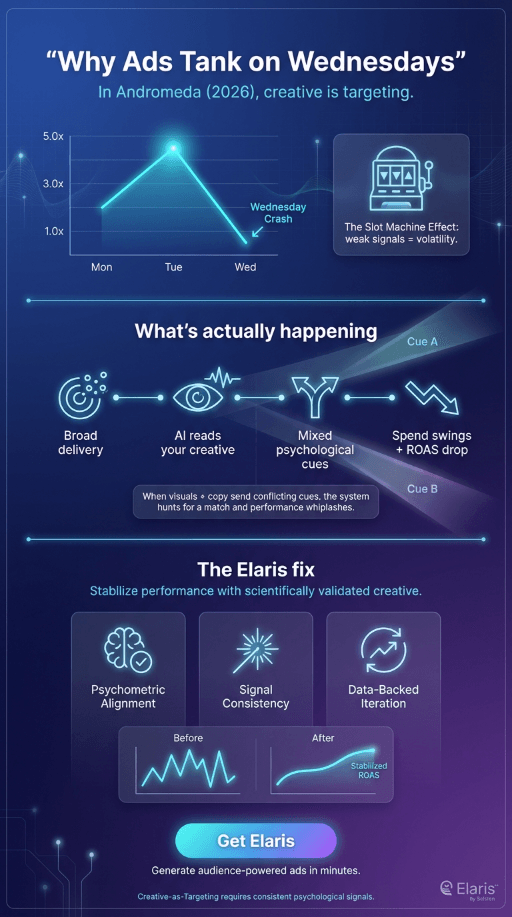
By Tuesday afternoon, you’re sitting at a 4x+ ROAS.
You cautiously scale budget by 15–20%.
Then Wednesday arrives. CPMs spike. Conversions slow. ROAS collapses to sub-1x.
Industry advice usually follows:
- “Let the algorithm learn.”
- “Zoom out.”
- “Check attribution.”
That advice made sense when Meta’s algorithm was still relatively blind.
It doesn’t anymore.
What you’re seeing is not learning phase volatility.
It’s psychological ambiguity.
What Andromeda Is Actually Optimizing For
Under Andromeda, Meta’s AI continuously analyzes three layers of every ad:
- Semantic meaning – what the copy implies
- Visual intent – what the imagery signals socially and emotionally
- Psychological resonance – which motivations the ad aligns with
If these layers align, delivery stabilizes quickly.
If they conflict, Meta serves the ad to multiple psychological sub-audiences, fails to find a consistent conversion pattern, and re-enters exploration mode, burning spend in the process.
A common failure mode looks like this:
- Copy emphasizes safety, certainty, harm avoidance
- Visuals signal status, aspiration, social dominance
To a human, that feels “fine.” To Andromeda, it’s contradictory.
The system hedges. Performance decays. ROAS tanks.
Why A/B Testing Quietly Stopped Working
For years, “test everything” was the gold standard.
Today, A/B testing without psychological intent creates more noise than signal.
When you test dozens of gut-driven variants, you might find a winner, but you rarely understand why it worked. When that creative fatigues, you’re back to guessing.
This is how high-growth brands burn through Series A capital while telling themselves they’re being data-driven.
In the Andromeda era, random testing increases volatility.
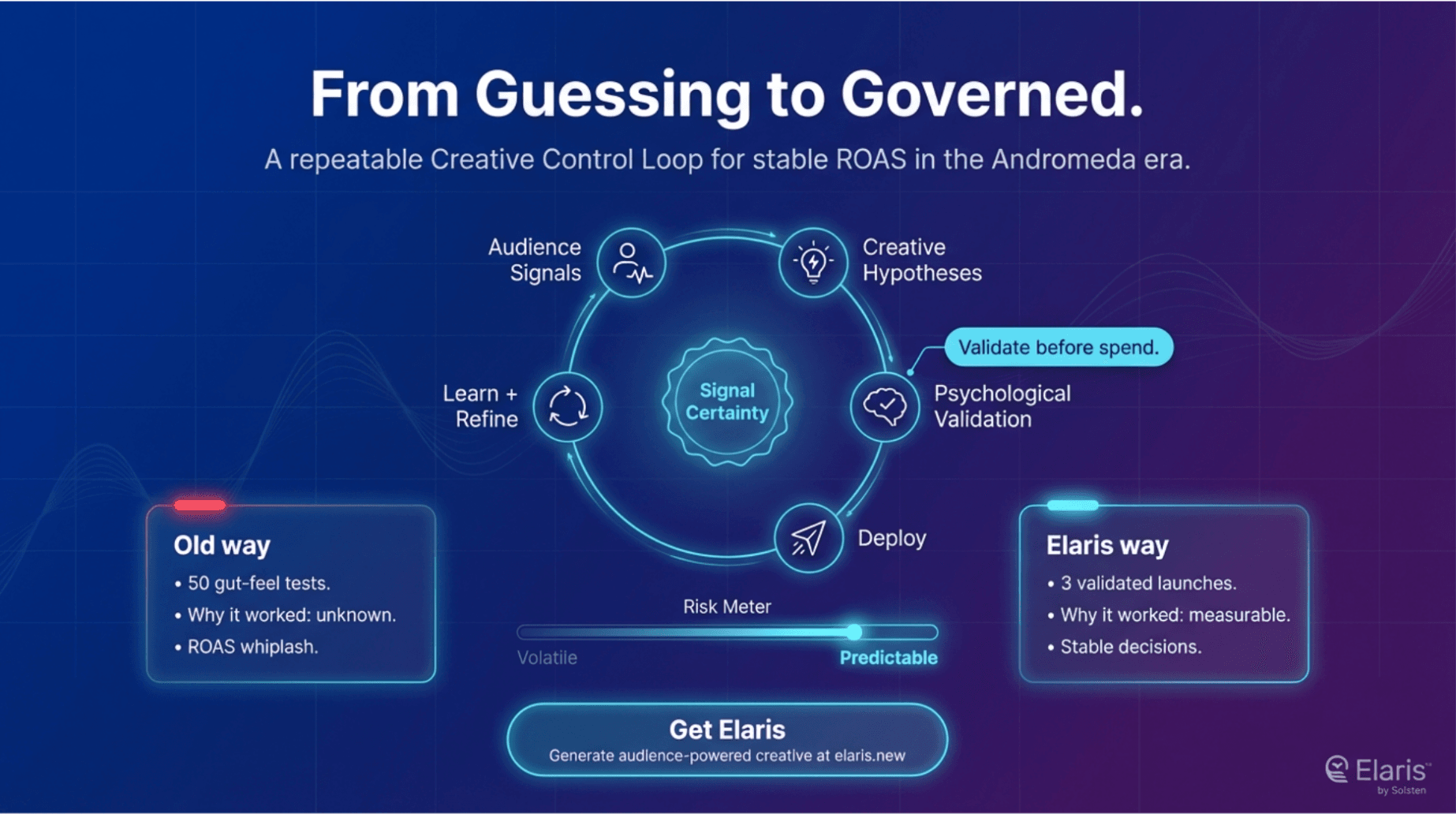
The Shift: From Creative Guesswork to Signal Certainty
To stabilize performance, you don’t need more variations.
You need clearer psychological intent.
This is where Elaris changes the dynamic.
Built on Solsten’s database of over 200,000+ psychologically modeled audiences (digital twins built from nearly 2 million real human assessments), Elaris allows you to design ads that send a single, legible psychological signal to Meta’s AI.
When you use Elaris, you’re not just “making an ad.”
You’re encoding a specific psychological resonance, such as openness to experience, conscientious consumption, or status signaling, that Andromeda can recognize immediately.
Try Elaris For Free - 3 Day Free Trial. $27/day Starter. Guaranteed results or money back, no questions asked.
The result is not luck. It’s comprehension.
The Three Foundations of Stable Meta Performance
1. Psychometric Alignment
Your hook, visuals, and framing must point to the same internal motivation.
2. Signal Consistency
Remove conflicting emotional triggers. One audience. One psychological throughline.
3. Causal Learning
Stop optimizing for “what worked.” Start understanding why it worked so results compound.
This is how ROAS becomes predictable instead of episodic.
Why High-Growth Agencies Are Repositioning Around Psychology
Clients don’t actually care about CTRs or CPMs.
They care about predictability.
The agencies winning in 2026 aren’t those with the most tactical media buyers. They’re the ones offering Psychological Creative as a Service.
When you can walk into a QBR and say:
“This creative direction aligns with verified motivations across thousands of comparable profiles,”
You stop being a cost center.
You become a certainty provider.
Summary: Reclaiming Control From the Algorithm
Meta removed your interests. They removed your lookalikes. They removed your manual granularity.
But they left you the most powerful lever in advertising:
Human psychology.
Elaris makes that lever usable systematically, scientifically, and at scale.
Stop gambling with creative. Stop letting Wednesdays decide your margins.
If you want to win in the Andromeda era, you have to speak the language the system actually listens to.
Frequently Asked Questions (FAQ)
1. Why do my Meta or Facebook ads work one day and fail the next?
Answer: This performance volatility is caused by weak or conflicting creative signals. Under Meta’s Andromeda update, the algorithm uses your ad creative, not manual targeting, to find your audience. If the psychological signal is unclear, the system fluctuates delivery while searching for a match, resulting in inconsistent ROAS.
2. What is “Creative-as-Targeting” in 2026?
Answer: Creative-as-Targeting means Meta’s AI analyzes your ad’s visuals, copy, and emotional tone to determine who sees it. Your creative functions as the audience filter, making psychological alignment more important than interests or lookalikes.
3. How does Elaris use psychology to improve ad performance?
Answer: Elaris maps ad creative against Solsten’s database of over 2 million validated first-party psychological profiles representing 3.4bn people globally. This ensures ads align with real motivations—values, traits, and drivers—so Meta’s AI can stabilize delivery faster and reduce wasted spend.
4. Can Elaris help with high-ticket DTC categories like supplements or cosmetics?
Answer: Yes. High-ticket DTC categories rely heavily on psychological motivations such as self-improvement, harm avoidance, and social signaling. Elaris identifies which drivers matter most for your audience, enabling faster scaling with more consistent ROAS.