
Creative Is the New Targeting
Solsten Staff • 2026-02-04
Why AI-Driven Media Buying Now Requires Human Psychology
TL;DR: In 2026, manual audience targeting is no longer a competitive advantage. Under Meta’s Andromeda and Advantage+ automation, ad creative itself determines audience delivery. Brands and agencies that don’t design creative using human psychology are no longer targeting… they’re guessing.
The Death of the “Technical” Media Buyer
For most of the last decade, the media buyer was the wizard.
They knew where to click.
What to exclude.
Which lookalike stack would unlock scale.
They were hired for their ability to navigate Facebook’s Ads Manager like a cockpit.
In 2026, that cockpit is sealed shut.
Between Meta’s Andromeda update and full Advantage+ automation, the machine now controls:
- Bidding
- Budget allocation
- Audience discovery
- Optimization logic
If your agency is still pitching “granular targeting” as a core competency, you’re not just behind.
You’re selling something that no longer exists.
The algorithm is the buyer now.
And the only remaining way to tell it who your customer is…is through creative.
Creative Is the New Targeting
This isn’t a metaphor.
It’s a mechanical reality.
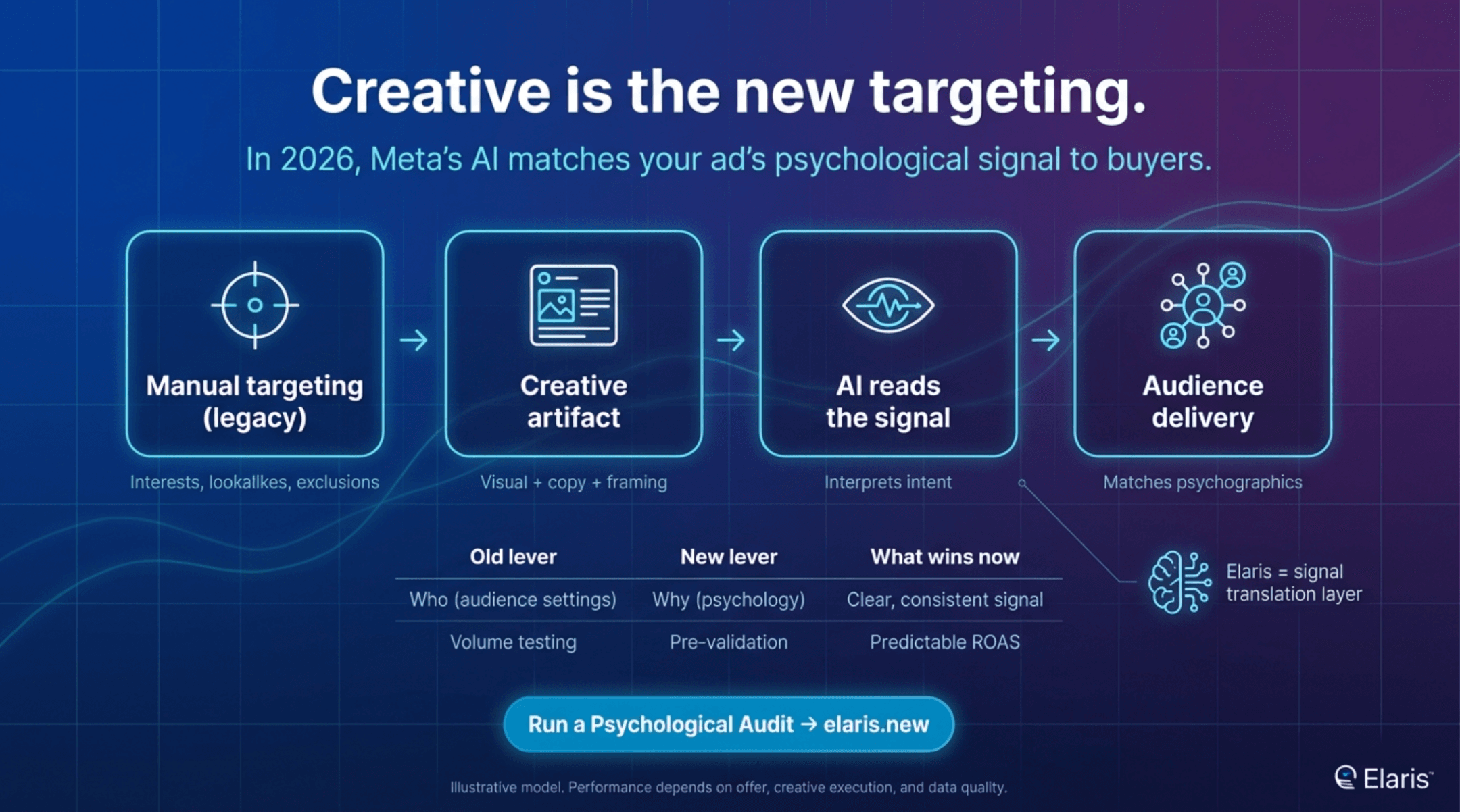
Meta no longer asks you to define an audience.
It asks you to upload an artifact.
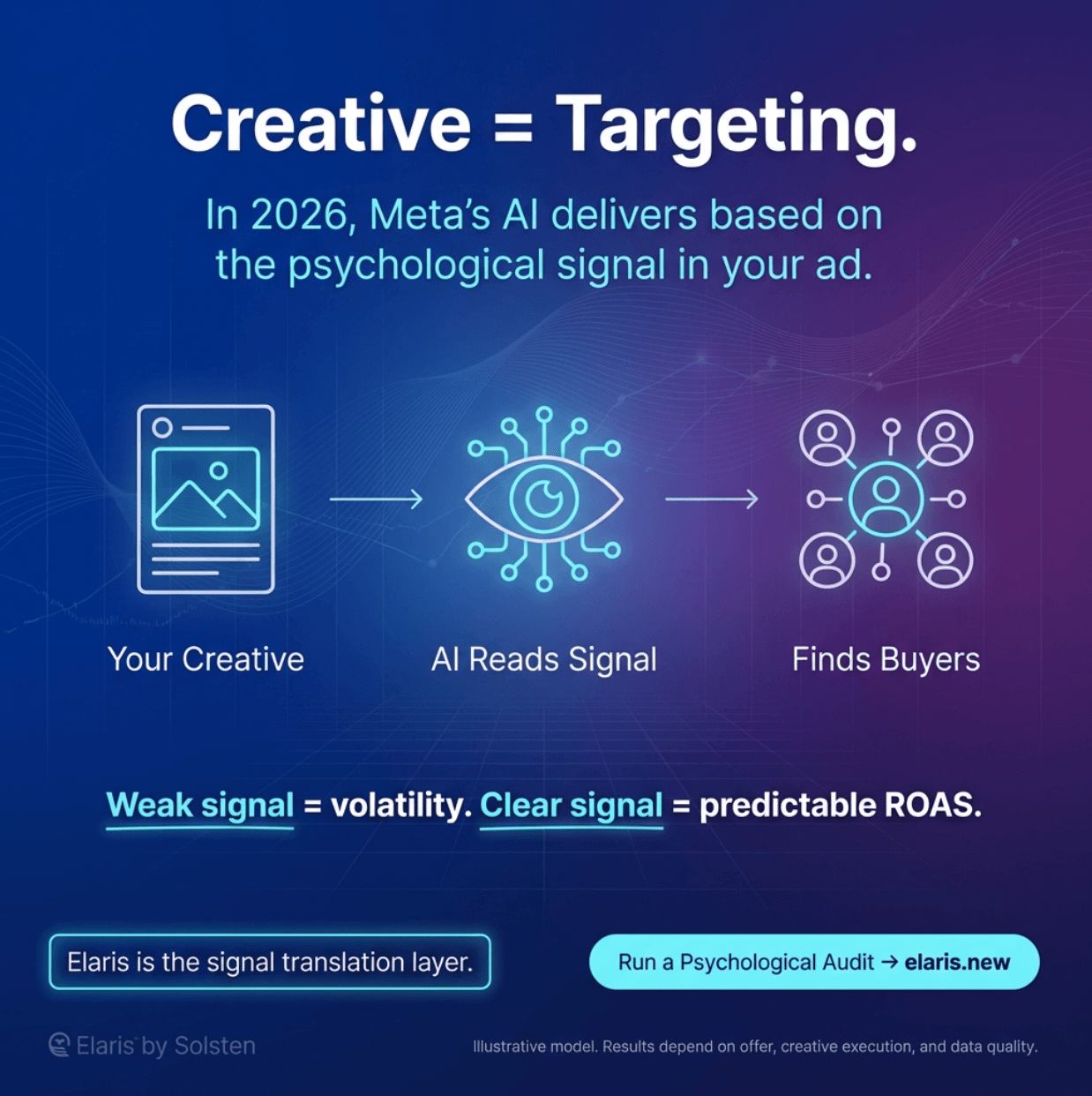
That artifact, your ad, is scanned, interpreted, and matched to humans based on what it signals.
Which means a new rule governs performance:
If your creative doesn’t encode psychological intent, the algorithm has nothing useful to work with.
That’s why performance feels volatile. That’s why CPMs spike randomly. That’s why “pretty” ads quietly fail.
What Is Creative-as-Targeting?
Quick Answer:
Creative-as-Targeting is a performance marketing approach where an ad’s visual, semantic, and psychological elements act as the primary audience filter. In 2026, Meta’s AI uses computer vision and natural language processing to interpret an ad’s intent and match it to users whose psychometric profiles, motivations, values, and personality traits, align with that signal.
In other words:
You don’t tell Meta who to target.
You show it why someone would care.
The Shift From “Who” to “Why”
The old workflow looked like this:
“Find people interested in Organic Skincare and Yoga.”
The Andromeda workflow looks like this:
“Here is an ad that signals harm avoidance, purity, and self-care.”
Meta’s AI scans the creative.
Identifies the psychological signal.
Finds the small percentage of the population whose internal motivations match.
This is faster and more accurate than any human targeting logic ever was.
But there’s a catch.
The system is only as good as the signal you feed it.
Generic creative produces generic delivery.
Mixed signals produce volatility.
Aesthetic-only ads drift.
And when the AI drifts, your ROAS dies quietly.
##The Elaris Moat: Engineering the Signal
This is the gap Elaris exists to close.
Elaris isn’t a “creative tool.” It’s a translation layer.
On one side:
Meta’s machine intelligence.
On the other:
Solsten’s database of 200,000+ psychologically modeled audiences representing billions of people globally.
Most agencies still test like this:
- “Let’s try a dog.”
- “Let’s add a discount badge.”
- “Let’s make it punchier.”
That isn’t strategy.
It’s aesthetic roulette.
Elaris replaces guesswork with psychological validation.
By analyzing your customer base through Solsten, we identify which Big Five personality traits and core motivations actually drive LTV.
Example:
If your best customers score high in Conscientiousness, they do not want hype.
They want structure, logic, and proof.
If you send the AI hype-driven creative for a conscientious audience, the system fails… not because the product is wrong, but because the signal is.
Elaris ensures the signal and the human are aligned before spend.
Try Elaris For Free - 3 Day Free Trial. $27/day Starter. Guaranteed results or money back, no questions asked.
##The Agency Crisis: From Operator to Strategist
The real threat to agencies isn’t AI.
It’s irrelevance.
If your value is “running ads,” you’re competing with a toggle inside Meta.
A founder can turn on Advantage+ and get 80% of tactical execution in minutes.
To survive, agencies must move up the value stack.
The New Growth Hierarchy
Level 1 — The Past Technical media buying: hacks, bids, audiences.
Level 2 — The Present Content volume: UGC, high-frequency testing.
Level 3 — The Future Psychological creative validation: predictable ROAS through intent.
When you use Elaris, your pitch changes fundamentally.
You don’t say:
“We’ll test 50 ads and see what sticks.”
You say: “We analyzed your customers against 200,000+ psychologically modeled audiences representing billions of people globally. They’re driven by social achievement and openness. We engineered three creative pillars to trigger those motivations. Here’s why we expect performance before launch.”
That’s not a service pitch.
That’s a certainty pitch.
Case Study: The High-Openness Shopper
Consider a DTC clothing brand.
Traditional targeting: Fashion, luxury goods. ** Psychological reality (via Elaris)**: The top 1% of spenders score extremely high in Openness to Experience.
These buyers aren’t trying to fit in. They’re exploring identity. ** The Old Way**: A model in a trendy street. Signal: social proof.
The Elaris Way: An ad focused on texture, sensory detail, and uniqueness of design.
Signal: exploration and self-expression.
When uploaded, Meta’s Andromeda AI detects the exploration signal and bypasses the mass fashion audience entirely.
Result:
- Lower CPA
- Higher AOV
- Dramatically slower creative fatigue
Not because the ad was prettier.
Because it spoke the right psychological language.
Try Elaris For Free - 3 Day Free Trial. $27/day Starter. Guaranteed results or money back, no questions asked.
The 2026 Reality: Psychology or Bust
Andromeda was the final nail in manual targeting.
We now live in a world where:
- The best technician loses
- The best psychologist wins Elaris gives you back control: not by fighting the algorithm, but by feeding it something it can actually understand.
You’re no longer gambling on delivery.
You’re designing for recognition.
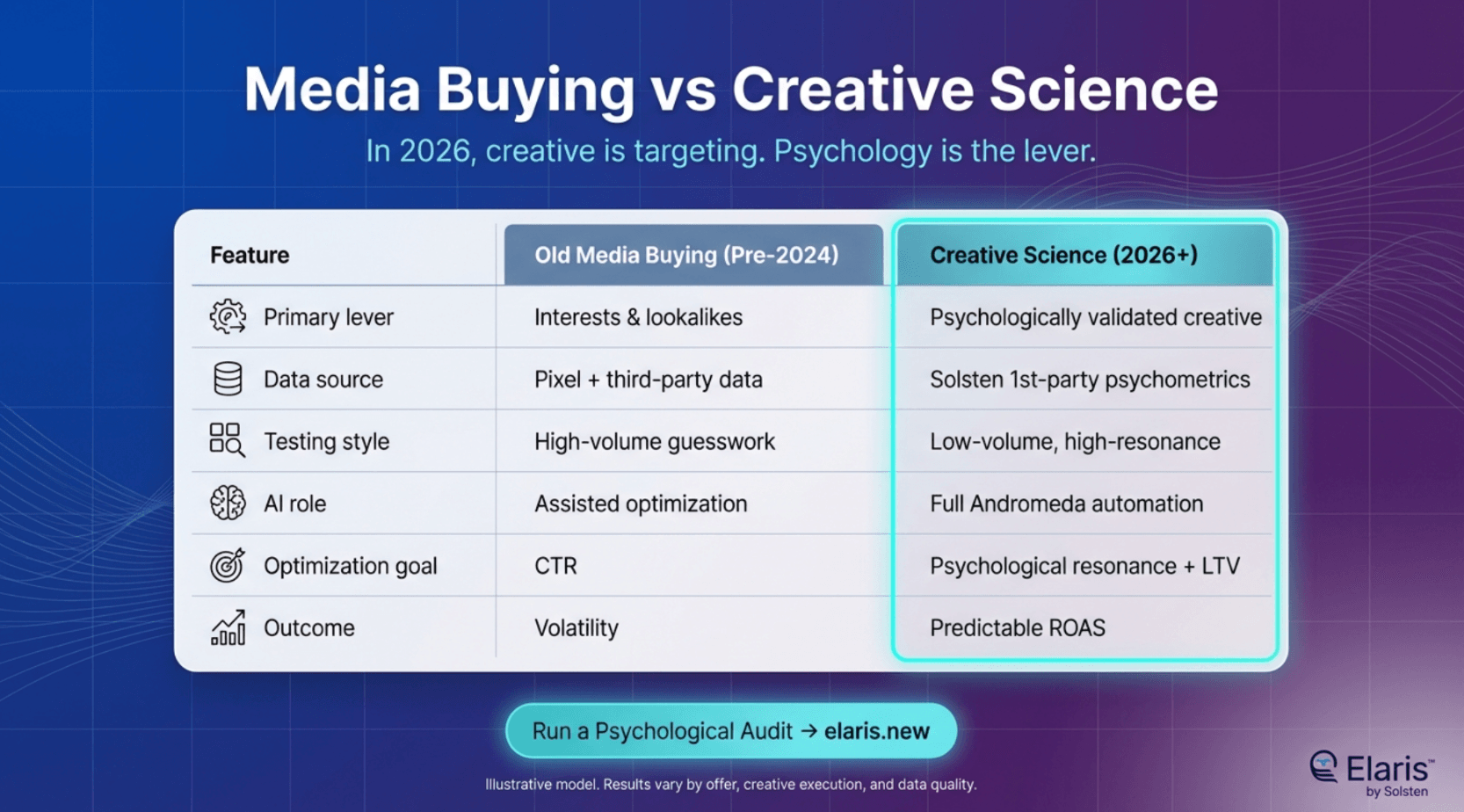
Summary: Media Buying vs Creative Science
Frequently Asked Questions (FAQ)
1. If Meta’s AI is so smart, why do I still need Elaris? Meta’s AI is a delivery engine, not a strategist. It can only optimize based on the creative signal you provide. If that signal is weak or psychologically misaligned, budget is wasted. Elaris ensures the signal is clear, intentional, and grounded in real human data.
2. What kind of psychological data does Solsten provide? Solsten provides validated first-party psychometric data, including Big Five personality traits, human values (e.g., Benevolence, Power), and core motivations (e.g., Achievement, Security). Elaris maps these traits directly to creative decisions.
3. How does creative-as-targeting affect CPMs? When creative resonates psychologically, Meta’s AI assigns higher relevance and engagement scores. This reduces auction friction, resulting in lower CPMs and more stable delivery.
4. Can Elaris be used for both B2B and DTC? Yes. While surface triggers differ, the underlying psychology is the same. B2B often emphasizes competence and security; DTC may emphasize self-expression or pleasure. Elaris supports both.
5. Is this the same as Dynamic Creative Optimization (DCO)? No. DCO shuffles elements to find winners by chance. Elaris is pre-validation, it tells you what to build and why before spend, eliminating the testing tax.