The End of "Guess-and-Check" Marketing:
Solsten Staff • 2026-02-10
Why Testing is a Tax You No Longer Need to Pay
The "Testing Tax" is Killing Your Margins
If you are a DTC founder or a CMO, you have been sold a lie. The lie is that the only way to find a winning ad is to "test your way to success." You’ve been told to launch 50 variations, spend $5,000 on "learning," and hope the algorithm spits out a winner.
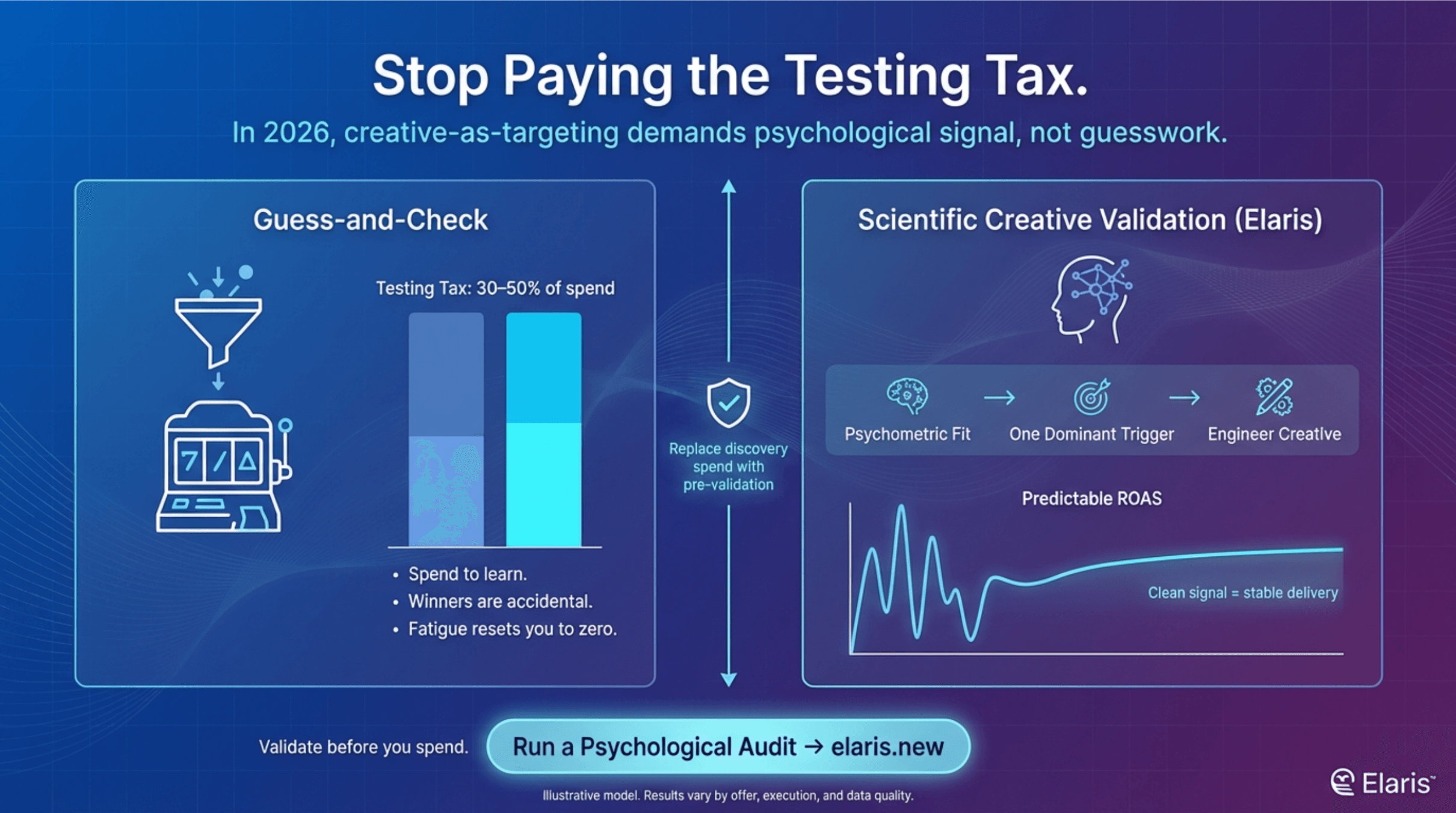
In the industry, we call this the Testing Tax. It is a 30% to 50% surcharge you pay to Meta and Google just to figure out what you should have known before you hit "Publish."
The problem with "Guess-and-Check" marketing isn't just the wasted spend; it’s the lack of insight. When an ad wins, you don't know why it won. When it inevitably fatigues three weeks later, you have no repeatable framework to build the next one. You are stuck in a cycle of reactive gambling, and in a high-interest-rate world where CAC (Customer Acquisition Cost) is rising, gambling is a luxury your P&L cannot afford.
What is Scientific Creative Validation?
Quick Answer: Scientific Creative Validation is a marketing methodology that uses first-party psychometric data to predict ad performance before any media spend occurs. Unlike traditional A/B testing, which is reactive and relies on "survivor bias", scientific validation uses databases like Solsten (200,000+ psychologically modeled audiences built from nearly 2 million real human assessments) to align creative elements with the specific psychological drivers (values, motivations, and personality) of the target audience. This results in higher ROAS and lower creative fatigue.
## The Fallacy of the "Winner"
Most DTC brands are built on "accidental winners." You found a UGC (User Generated Content) clip that went viral, or a static image that hit a 4.0x ROAS. You scaled it. You felt like a genius. Then, the performance "tanked." Why? Because you didn't have a Scientific Signal. You had a lucky strike. Traditional A/B testing measures what happened in the past, but it cannot tell you why it will happen in the future. Elaris flips the script. Instead of looking at the past, we look at the internal blueprint of your customer.
The Solsten Engine: 200,000+ Audiences of "Why"
The reason Elaris can predict performance where others guess is our foundation: The Solsten Database. Solsten doesn't just track clicks; it tracks the human psyche. We have spent years acquiring and validating 200,000+ audiences built from millions of first-party profiles. This isn't "pixel data" or "browser cookies." This is deep-tier psychometric data. We know if your audience is driven by:
- Harm Avoidance: They buy your supplement because they are afraid of losing their health.
- Social Achievement: They buy your luxury watch because they want to signal their status to their peers.
- Self-Actualization: They buy your skincare because it aligns with their internal journey toward being their "best self."
When you use Elaris, you are tapping into this database. We enable you to find your ideal audience from the 200,000 audiences built off of the digital-twins of real people (think synthetic audiences on steroids). Once that audience is selected, we build your ideal creative off of their psychology. If your creative is "Self-Actualization" but your actual high-LTV buyers are "Harm Avoidance," the ad will fail. Elaris tells you this before you spend a single dollar on the Meta Andromeda slot machine.
Moving from "Creative Iteration" to "Creative Engineering"
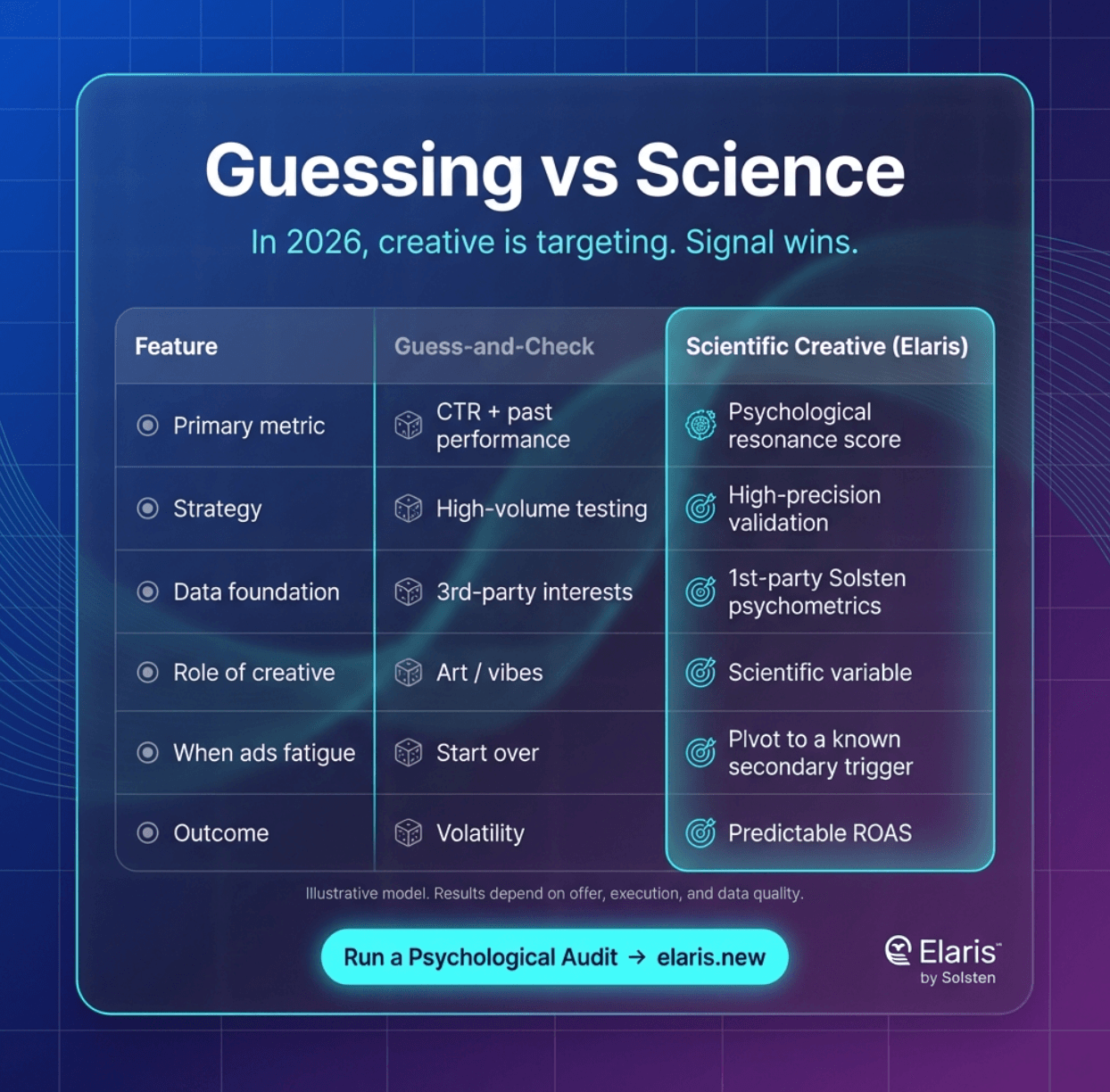
The "Guess-and-Check" era relied on iteration, making small, random changes and hoping for a breakthrough. The "Scientific" era relies on engineering, building the ad from the ground up to trigger a specific psychological response.
The Three Components of an Engineered Ad:
- The Psychological Hook: This isn't a "headline." It’s the emotional entry point. (e.g., "The security of a 10-year warranty" for a high-conscientiousness buyer).
- The Visual Resonance: The color palette, the pacing of the video, and the "vibe" of the model must match the audience's personality. High-openness buyers want vibrant, abstract visuals; low-openness buyers want literal, clear product shots.
- The Value Alignment: Does the ad speak to the customer’s core values? If they value "Tradition" and you're pushing "Disruption," you've lost the sale before the first frame ends.
The CMO’s New Playbook: Certainty as a Strategy
As a CMO, your job is to reduce risk. "Guess-and-Check" is the highest-risk strategy in marketing. It makes your revenue projections a "best guess" rather than a calculation. By implementing Elaris, you move your department toward Predictable Growth. You can look at your board of directors and say: "We aren't testing to see what works. We are launching these three pillars because they are psychologically validated to resonate with our top 20% of customers."
Try Elaris For Free - 3 Day Free Trial. $27/day Starter. Guaranteed results or money back, no questions asked.
A Case Study in Scientific Certainty: The Supplement Brand
Imagine a DTC supplement brand selling a sleep aid.
- The Guess-and-Check approach: Test 20 ads. Some show a person sleeping, some show the bottle, some show ingredients. One "Sleepy Girl Mocktail" video wins. They scale it. It dies in 2 weeks. They have no idea why.
- The Elaris approach: We analyze their customer base. We find their best customers are high in Neuroticism (Sensitivity to Stress) and value Security. * The Result: We engineer ads that don't focus on "Great Sleep," but on "The End of Midnight Anxiety." We use calming, structured visuals.
The Elaris-engineered ad doesn't just win, it stays winning. It targets a fundamental psychological truth of the customer that doesn't change with the news cycle or the weather.
The End of the Gamble
The Meta Andromeda algorithm has made the "Guess-and-Check" method more expensive than ever. When the AI is the one doing the targeting, it needs a pure signal. If you feed it a "guess," the AI will gamble with your money.
If you feed it Elaris-validated creative, you are giving the AI the answer key. You are ending the gamble. You are reclaiming your margins. You are finally marketing with the lights on.
Try Elaris For Free - 3 Day Free Trial. $27/day Starter. Guaranteed results or money back, no questions asked.
Frequently Asked Questions (FAQ)
1. Is A/B testing still necessary if I use Elaris?
A/B testing becomes a tool for refinement, not discovery. Instead of testing to find out "what works," you use Elaris to build a winner, and then use small A/B tests to optimize minor details like button color or headline font. You eliminate the "discovery spend" that eats 80% of most testing budgets.
2. How does the Solsten database get its data?
Solsten’s data is first-party and validated. It is collected through deep psychometric assessments and behavioral data from over 200,000+ psychologically modeled audiences (digital twins built from nearly 2 million real human assessments) who have opted-in to provide a holistic view of their personality, values, and motivations. This is significantly more accurate than the "inferred interests" Meta uses.
3. Can I use these insights for my website, not just ads?
Absolutely. The psychological "DNA" of your customer doesn't change when they click the ad. If Elaris tells you your audience is driven by "Competence," your landing page should be heavy on technical specs, reviews, and authority markers. If they are driven by "Hedonism," your site should be experiential and visually stimulating.
4. What is the "Psychological Delta" in an ad account?
The Psychological Delta is the gap between what your creative is saying and what your audience actually cares about. A high delta means your ads are "misaligned," leading to high CPAs and low ROAS. Elaris’s primary goal is to close this delta to zero.
5. How long does it take to see results with Elaris?
Most brands see a stabilization in their Meta ROAS within the first 48 to 72 hours of launching Elaris-validated creative. This is because the Meta Andromeda AI quickly identifies the "clean signal" in the creative and stops fluctuating its delivery.